Why Retaining Walls Matter in Cedar Rapids
Eastern Iowa's rolling terrain, heavy clay soils, and dramatic seasonal swings make retaining walls one of the most valuable investments a homeowner can make in their property. Whether you're dealing with a sloped backyard that washes out every spring rain, a driveway that's slowly losing its shoulder, or a walkout basement that needs a stable grade change, a properly engineered retaining wall solves the problem permanently. Beyond function, a well-designed wall transforms unusable slope into flat, livable square footage — space for patios, garden beds, fire pits, or simply a level lawn where none existed before.
At Landforms Design Inc, we've been building retaining walls throughout Cedar Rapids and Eastern Iowa since 1995. In that time, we've learned that a wall is only as good as what you can't see: the base, the drainage, and the backfill. Iowa's clay-heavy soil expands when saturated and contracts when it dries, and our winters bring dozens of freeze-thaw cycles each year. A wall built without proper engineering for these conditions will bulge, lean, or fail within a few seasons. A wall built correctly will outlast the homeowner who installed it.
Our Approach to Retaining Wall Design
Every retaining wall project starts with an on-site evaluation of your slope, soil, drainage patterns, and the load the wall will need to bear. We look at how water moves across your property during a heavy Iowa thunderstorm, where the high point of your yard sits relative to your foundation, and whether the wall is purely decorative or genuinely load-bearing — for example, holding back a slope beneath a driveway or patio. This distinction matters enormously for engineering: a 24-inch garden wall has very different requirements than a 5-foot wall retaining a graded slope behind a home.
For taller walls or walls supporting significant loads, we use our Uvision 3D Landscape Creator software to model the wall in place on your property before a single block is set. This lets you see exact wall heights, cap styles, color blends, and how the wall will interact with existing patios, steps, or plantings. It also lets us calculate setback, batter (the slight backward lean built into every properly engineered wall), and reinforcement needs with precision rather than guesswork.
Materials We Use
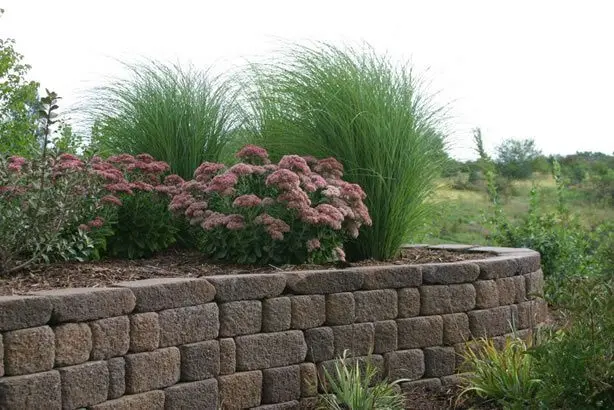
We build almost exclusively with Unilock segmental retaining wall systems, chosen specifically for their performance in northern climates. Unilock manufactures its units to a high-density specification with low water absorption, which is the single most important factor in freeze-thaw durability — a block that absorbs less moisture is far less likely to spall, crack, or flake after repeated winters. We offer several Unilock wall series depending on the project:
- Estate Wall and Highland Stone for natural, tumbled stone aesthetics that suit traditional Iowa homes
- Ledgestone and Rivercrest for a more contemporary, linear look popular in newer Cedar Rapids neighborhoods
- Modular block systems rated for engineered geogrid reinforcement on taller walls
- Matching wall caps, step units, and column kits so the finished wall reads as one cohesive system, not a patched-together structure
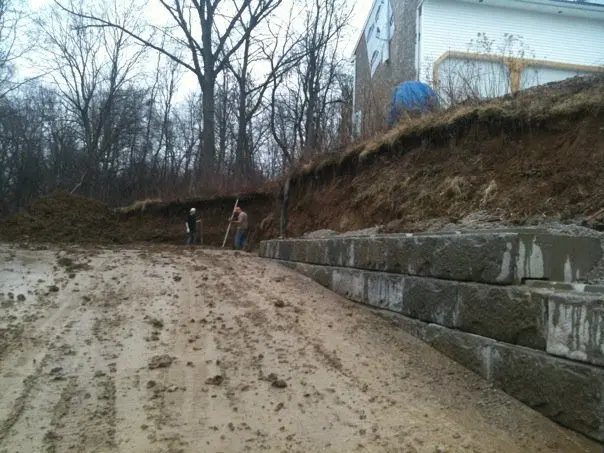
Every wall over roughly 3 feet in height (and many shorter walls depending on soil and slope) is built with geogrid soil reinforcement — horizontal layers of high-strength synthetic mesh embedded in the compacted backfill and locked into the wall units at engineered intervals. This is what actually holds back the soil; the visible wall face is really more of a formwork for the reinforced soil mass behind it. Skipping geogrid is one of the most common corners cut by inexperienced installers, and it's the number-one reason walls fail.
Drainage: The Part No One Sees but Everyone Needs
The majority of retaining wall failures we're called to repair in Cedar Rapids trace back to one cause: water. Without a way to escape, hydrostatic pressure builds up behind a wall during spring thaw and heavy rain, and that pressure will eventually push even a well-built wall out of alignment. Our standard wall installation includes a perforated drain tile running the full length of the wall base, wrapped in filter fabric and bedded in clean, angular drainage stone (typically 3/4-inch clear stone, not the rounded pea gravel that compacts and clogs over time). This drain tile ties into a daylight outlet or a solid discharge line that carries water safely away from the wall and your foundation. We also backfill with free-draining granular material rather than the native clay, since compacted clay behind a wall holds water exactly where you don't want it.
What the Process Looks Like
After your free consultation and 3D design approval, our crews begin with excavation to remove existing soil down to undisturbed, competent subgrade — often 8 to 12 inches below the base of the first course, depending on wall height. We compact a crushed limestone base in lifts, checking it with a plate compactor to ensure it won't settle unevenly later. The first course is set dead level and is the most critical step in the entire build, since every course above follows its line. As we build up, we backfill and compact in stages, install geogrid layers per the engineering plan, and set the drain tile system. Cap units and any integrated steps, columns, or lighting conduit go in last, followed by final grading and, where applicable, sod or seed restoration along the top of the wall.
Most residential retaining wall projects in Cedar Rapids take anywhere from three days to two weeks depending on length, height, and site access. We keep homeowners informed at each phase and walk the finished wall with you before calling the job complete.
Iowa Conditions That Make This Service Essential
Cedar Rapids sits in a region with heavy clay and clay-loam soils that hold water and swell dramatically when saturated — a phenomenon called expansive soil movement. Combine that with a climate that sees freezing nights and thawing days repeatedly through late fall, winter, and early spring, and you have ideal conditions for soil movement, frost heave, and erosion on any unretained slope. The Cedar and Iowa Rivers watershed also means many area properties deal with seasonal high water tables, particularly near Cedar Lake, Ellis Park, and the neighborhoods along Indian Creek. A retaining wall designed without accounting for these realities is designed to fail. We build every wall assuming Iowa's worst-case wet spring and coldest-case winter, not just average conditions.
Professional Installation vs. DIY
Retaining wall kits are widely available at home improvement stores, and for a very short garden edge (under about 18 inches with no load above it), a careful DIYer can sometimes get acceptable results. Beyond that, the risks climb quickly. Homeowners without engineering knowledge routinely underestimate base depth, skip geogrid entirely, backfill with the same clay they dug out, or ignore drainage — all of which lead to a wall that looks fine for a year or two and then bulges, cracks, or falls over, at which point the repair costs far more than doing it right the first time. There's also a safety and liability dimension: a failed retaining wall near a driveway, patio, or property line can cause real damage or injury. Professional installation gives you engineering-backed design, proper permits where required, warrantied materials, and a crew that has built hundreds of walls through actual Iowa winters — not just one.
Frequently Asked Questions
How long does a Unilock retaining wall last in Iowa?
A properly engineered and installed Unilock retaining wall with geogrid reinforcement and correct drainage will typically last 50 years or more, even through Cedar Rapids' harsh freeze-thaw cycles. The high-density, low-absorption block material resists the surface spalling that lower-quality concrete block suffers after repeated winters. The lifespan of any wall, however, is only as good as its drainage system — walls that fail early almost always do so because of trapped water, not the block material itself.
Do I need a permit for a retaining wall in Cedar Rapids?
It depends on the wall's height and location. In general, walls under 4 feet measured from the bottom of the footing to the top of the wall do not require a building permit in most Eastern Iowa jurisdictions, but walls at or above that threshold, or walls that support a surcharge load like a driveway or structure, typically do require engineering review and a permit. Property line and easement restrictions can also apply. We handle the permitting process for you as part of every project that requires it, so you don't have to navigate city code on your own.
Can a retaining wall fix a wet or eroding backyard?
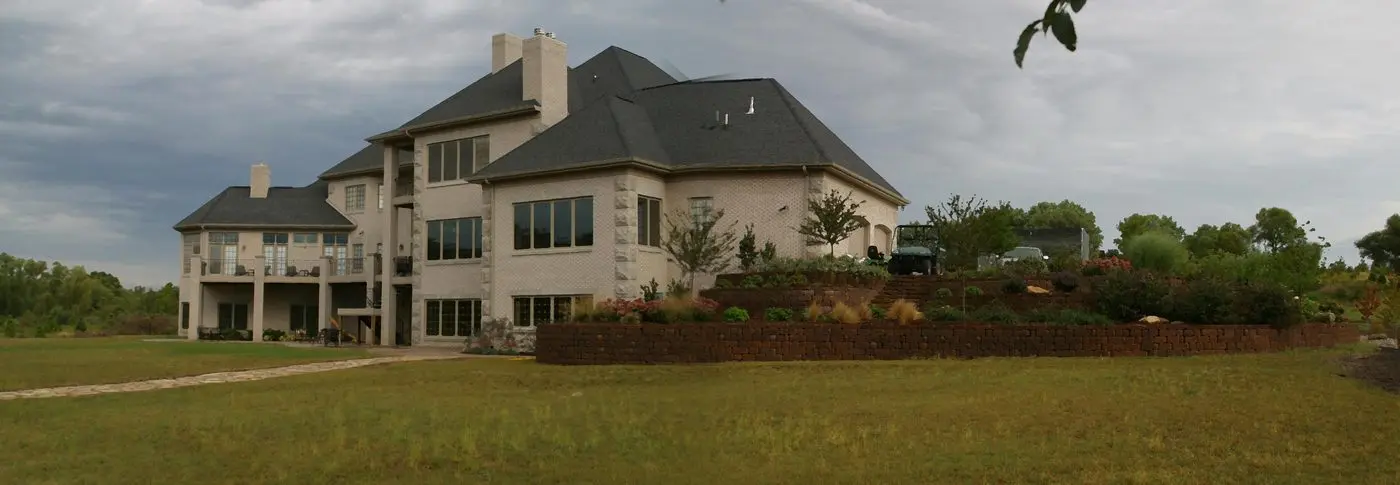
In many cases, yes. A retaining wall combined with proper grading and a drain tile system is one of the most effective ways to stop soil erosion on a slope and control where water goes on your property. Rather than letting water sheet down a hillside and carry topsoil with it, a terraced wall system slows and redirects water into a controlled drainage path. We often pair retaining walls with broader grading and drainage work for yards with chronic wet-spot or erosion problems.
What's the difference between a gravity wall and a geogrid-reinforced wall?
A gravity wall relies purely on the weight and mass of the wall units themselves to resist the soil pressure behind them, which limits practical height to around 3 to 4 feet depending on the block system and soil conditions. A geogrid-reinforced wall extends layers of high-strength synthetic mesh back into the compacted soil mass at engineered intervals, effectively turning the soil behind the wall into part of the structural system. This allows for taller walls, steeper retained slopes, and much greater long-term stability, which is why we use geogrid on the majority of walls we build in Cedar Rapids.
How much does a retaining wall cost in Cedar Rapids, Iowa?
Costs vary based on wall height, length, block selection, site access, and whether geogrid reinforcement or drainage work is required, so pricing is best determined with an on-site visit. Generally, taller walls cost more per square face foot than shorter ones because of the added excavation, base preparation, and reinforcement involved. We provide free, no-obligation estimates for every retaining wall project so you know exactly what to expect before work begins.
Ready to Get Started?
Contact Landforms Design Inc today for a free estimate. We serve Cedar Rapids and all of Eastern Iowa.
Request Your Free QuoteOr call us directly: (319) 899-4322