


Why Is My Yard Flooding? Common Causes
- 5 days ago
- 6 min read
A yard that stays soggy days after a storm is more than an annoyance. If you're asking, "why is my yard flooding," the real concern is usually what that water is doing while it sits there - softening soil, stressing grass, damaging plant roots, and putting pressure on patios, foundations, and walkways.
In Eastern Iowa, yard flooding often comes down to a few repeat issues: improper grading, compacted soil, poor runoff control, blocked drainage paths, or a landscape that was built for appearance but not for water movement. The right fix depends on where the water starts, where it is supposed to go, and what is preventing it from getting there.
Why is my yard flooding after every heavy rain?
If flooding happens only during a major storm and drains away quickly, that may be normal surface runoff. If it happens after every heavy rain, lingers for a day or more, or keeps returning to the same low spots, there is usually a drainage failure somewhere in the system.
The first place to look is slope. Water always follows grade, and even small elevation mistakes can create big problems. A yard may appear flat to the eye but still direct runoff toward the house, trap it in the center of the lawn, or push it against a patio edge where it has nowhere to escape.
In newer developments, this is especially common when finish grading was rushed or altered after construction. In older properties, years of settling can create shallow depressions that slowly become collection points. Add a downspout that discharges too close to the home, and a manageable drainage issue becomes standing water.
The most common reasons yards flood
Poor grading and low spots
This is one of the biggest causes of recurring yard flooding. If the ground does not pitch water away from the house and toward an appropriate outlet, the yard will hold water. That might mean a broad low section in the lawn, a swale that was never shaped correctly, or a patio installed without enough fall.
Grading problems are often subtle. A difference of an inch or two over several feet can determine whether water drains off or sits in place. That is why drainage work has to be treated as a construction issue, not a guess-and-check landscaping project.
Downspouts that dump water in the wrong place
Roof runoff adds up fast. During a strong storm, a single downspout can discharge a surprising volume of water into one concentrated area. If that outlet ends next to the foundation, into a mulch bed, or into a low part of the yard, the ground can saturate quickly.
Sometimes homeowners assume the lawn is the problem when the actual issue starts at the roofline. Extending downspouts or routing them into a proper drainage solution can make a major difference, but only if the discharge point is chosen carefully.
Compacted soil
Healthy soil absorbs water. Compacted soil does not. In many residential and commercial properties, heavy equipment, repeated foot traffic, or years of mowing over the same pattern can compress the soil enough to limit infiltration.
Clay-heavy soils, which are common in parts of Iowa, make this worse. Water tends to move slowly through dense clay, so once the surface seals up, runoff increases. In those cases, even a yard with decent grading can become saturated because the soil simply cannot absorb rain at the rate it is falling.
Blocked or undersized drainage systems
Some yards already have drainage features, but they stop working because they were poorly installed, undersized, or clogged with sediment and debris. A catch basin full of leaves or a buried drain tile crushed by equipment will not move water effectively.
This is where professional diagnosis matters. Installing more drains does not automatically solve the issue. If the system has no reliable outlet, if the pipe slope is wrong, or if water is being collected from too large an area, flooding will continue.
Hardscapes that redirect water
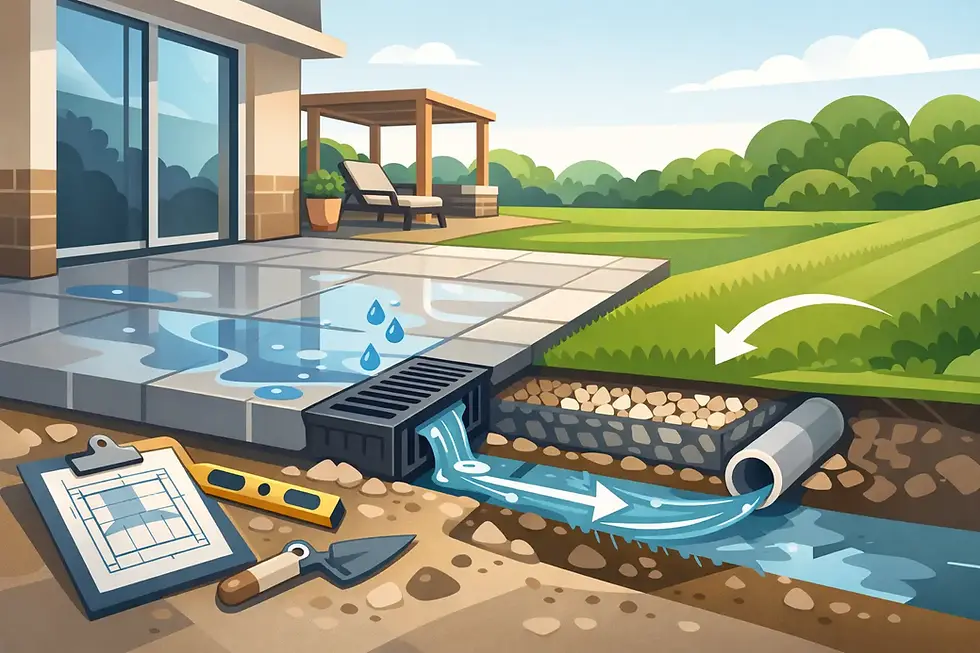
Patios, walkways, retaining walls, driveways, and sports courts all change how water moves across a property. When designed well, they help control runoff. When they are built without enough attention to grade and drainage, they can send water exactly where you do not want it.
A common example is a patio that traps water between the house and the hardscape surface. Another is a retaining wall that interrupts natural drainage without providing relief behind the wall. Water management should always be part of the design, not an afterthought once flooding appears.
What yard flooding can damage over time
Standing water is not just a lawn issue. It can undermine the performance and lifespan of the entire outdoor environment.
Grass may thin out or die because roots are starved of oxygen. Plant beds can become unstable as mulch floats, roots rot, and erosion exposes the base of shrubs and perennials. Hardscape surfaces may shift if the base below them becomes saturated. Freeze-thaw cycles can make this even worse in Iowa, where trapped moisture expands and stresses pavers, edging, and surrounding soils.
The most serious concern is when flooding occurs near the home or building. Water that sits near a foundation increases the risk of seepage, settlement, and structural moisture problems. If runoff regularly moves toward a basement wall or slab edge, it is worth addressing before it becomes a larger repair.
How to tell what is causing the problem
Start by paying attention during and right after a rain. Where does the water first appear? Does it pour from a downspout, run off a neighboring property, sheet across the lawn, or pool near a hardscape edge? The source matters because the visible puddle is not always the true starting point.
Next, look at how long the water stays. If puddles disappear within a few hours, infiltration may be slow but acceptable. If they remain the next day, there is likely a grading or soil issue. If water collects in the same place after every storm, that usually points to a built-in low area or blocked drainage path.
It also helps to consider what changed. Was a patio added recently? Was topsoil brought in? Did a fence, retaining wall, or neighboring construction alter runoff patterns? Yard flooding often begins after one change redirects water without anyone noticing until the next storm cycle.
Why quick fixes often fall short
When people search for answers to "why is my yard flooding," they often find simple solutions like adding more topsoil, drilling holes, or installing a random drain. Sometimes those help at the margins. Often they just move the problem a few feet away.
Drainage is a system. Surface slope, subsurface conditions, hardscape elevations, downspout discharge, and outlet location all have to work together. A French drain, for example, can be very effective in the right setting, but it is not a cure-all. If the surrounding grade still funnels water into the area faster than the drain can carry it away, the flooding remains.
The same is true for regrading. Regrading can solve a low spot, but if the corrected slope sends water toward a neighbor, sidewalk, or building, it creates a different problem. Good drainage design is about controlled movement, not just getting water away from one puddle.
When professional drainage work makes sense
If water is threatening your foundation, repeatedly damaging turf and plantings, or affecting patios, walkways, or retaining walls, it is time to look beyond temporary fixes. The best long-term solutions usually involve one or more of these approaches: correcting grade, reshaping swales, extending downspouts, improving soil performance, or installing collection and conveyance systems that fit the property.
For some sites, the answer is straightforward. For others, it takes a more complete design-build approach because drainage is tied to landscaping, hardscaping, and final elevations across the whole yard. That is especially true when the property is being upgraded anyway. Solving water problems during a larger outdoor project is often more efficient than trying to retrofit drainage after the work is finished.
In Cedar Rapids and across Eastern Iowa, changing weather patterns, heavy rains, and freeze-thaw stress make proper drainage even more important. A yard should not just look finished. It should be built to perform.
When water keeps collecting in the same places, the best next step is not guessing. It is understanding how your site is graded, where the runoff is coming from, and what durable correction will hold up over time. That is the kind of problem Landforms Design approaches with precision, because the yard you invest in should work as well as it looks.
A flooded yard is usually the landscape telling you something is out of alignment. Catch it early, fix it correctly, and you protect far more than your lawn.


Comments