


Landscape Drainage System Guide for Yards
- WIX EXPERT SEO SPECIALIST
- Jun 3
- 6 min read

A yard usually tells you when drainage is failing. Water stands near the patio for a day after rain. Mulch washes into the lawn. Downspouts carve trenches beside the foundation. In Eastern Iowa, where heavy spring rain, clay soils, freeze-thaw cycles, and summer storms all put pressure on the ground, a solid landscape drainage system guide starts with one fact: water will always find a path. The question is whether that path is controlled.
Good drainage is not a cosmetic upgrade. It protects foundations, preserves hardscapes, improves lawn health, and keeps outdoor spaces usable. For homeowners and property managers investing in patios, retaining walls, plantings, sports courts, or full site improvements, drainage should be part of the plan from the beginning, not something added after damage appears.
What a landscape drainage system guide should actually cover
Many people think drainage means adding one pipe or one catch basin where water collects. Sometimes that helps, but drainage problems rarely come from a single point. They come from grades that direct water the wrong way, compacted soils that slow infiltration, roof runoff concentrated in one area, or hardscape surfaces installed without enough slope.
A practical landscape drainage system guide should look at the whole site. That includes roof water, lawn elevations, planting beds, patios, walkways, retaining walls, neighboring properties, and the final discharge point. If one part of the system is ignored, water simply moves the problem somewhere else.
That is why professional drainage work begins with observation. Where does water enter the site? Where does it collect? How long does it remain after a storm? What structures or finished surfaces are in the way? The right answer for one property may be completely wrong for another, even on the same block.
The most common drainage problems in Eastern Iowa landscapes
In this region, poor drainage often shows up in predictable ways. Flat or low areas in the lawn stay soft for days. Water pools at the edge of driveways or patios because the surface pitch is too shallow. Downspouts dump roof runoff next to the house, overloading a small area. Retaining walls hold soil well but trap water behind them when drainage stone and outlet systems are missing.
Clay-heavy soils add another layer of difficulty. They do not absorb water as quickly as sandy soils, so runoff becomes a bigger concern. During freeze-thaw cycles, trapped moisture can also contribute to movement in pavers, wall systems, and concrete edges. What looks like a minor wet spot in April can become settling, erosion, or surface failure over time.
Commercial properties deal with many of the same issues, just at a larger scale. Parking lot runoff, pedestrian safety, and usable green space all depend on proper grading and water management. When drainage is ignored, maintenance costs rise and the property stops performing as intended.
Start with grading before you start adding products
The most effective drainage tool on a site is often not a drain at all. It is grading.
A properly graded yard moves water away from structures and toward appropriate collection or release points. That sounds simple, but grading requires precision. Too little fall and water sits. Too much slope and you create erosion, mowing problems, and unstable planting areas. On a property with patios, walls, steps, and planting beds, every elevation affects the next one.
This is where experience matters. A drain can collect surface water, but it cannot fix a site that was shaped incorrectly from the start. In many projects, reworking elevations solves more than adding extra drainage hardware. It also creates a cleaner finish because the landscape looks intentional rather than patched together.
Surface drainage vs. subsurface drainage
Most properties need one or both of these approaches.
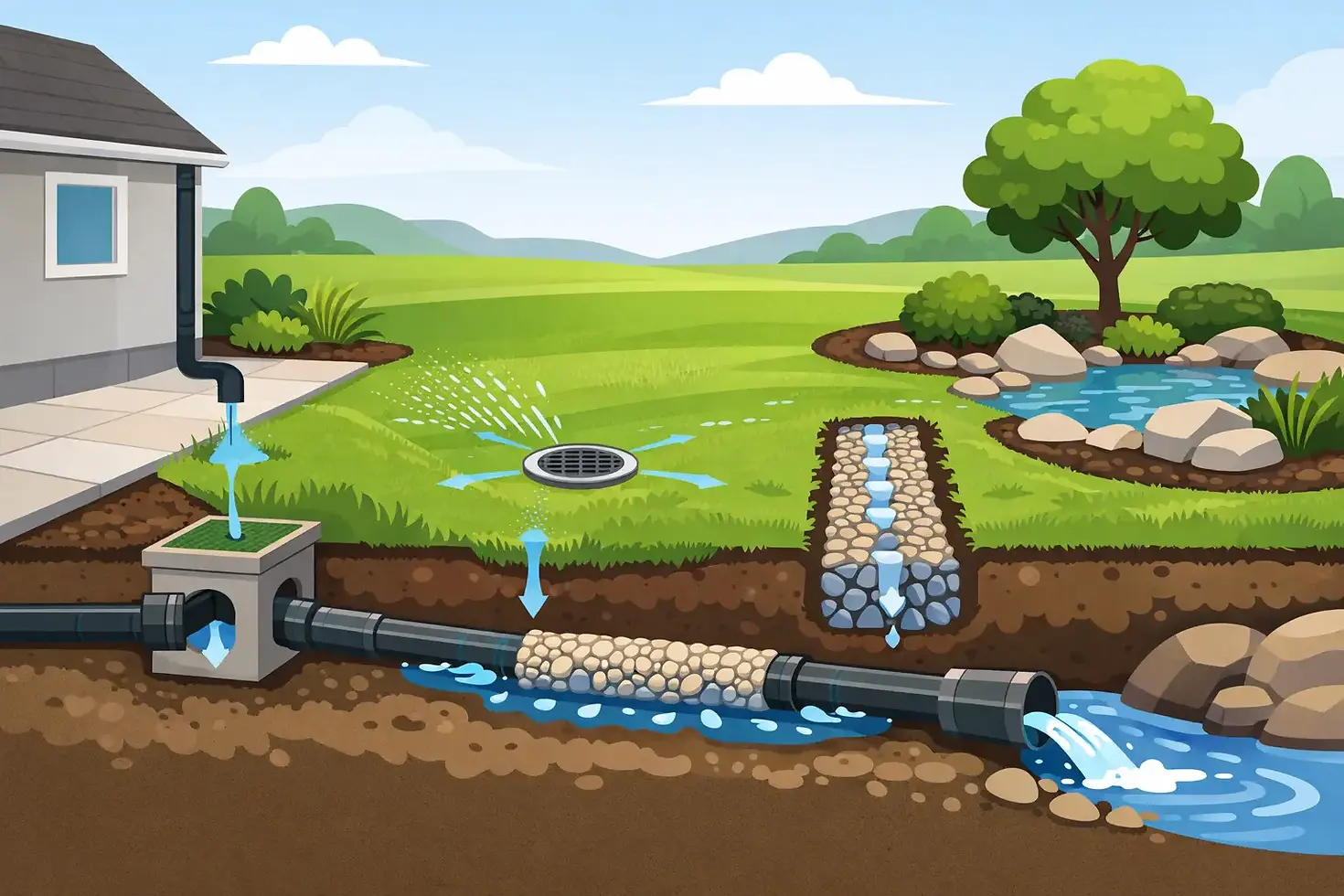
Surface drainage manages water that moves across the top of the ground. This may involve reshaping lawn areas, creating swales, pitching patios and walkways correctly, or using catch basins and channel drains in collection areas. Surface drainage is especially important around hardscapes, where runoff moves quickly.
Subsurface drainage handles water below the surface before it causes saturation or pressure. This often includes perforated drain tile, drainage stone, filter fabric, and outlet piping. It is commonly used behind retaining walls, in persistently wet turf areas, or where groundwater and slow-draining soils create long-term problems.
The trade-off is straightforward. Surface drainage is often simpler and easier to maintain, but it needs room and proper grading. Subsurface drainage is more hidden and can solve deeper moisture issues, but only if installed with the right materials, depth, slope, and discharge point. A buried pipe with nowhere to drain is not a system.
Drainage solutions that work when they are designed correctly
Several drainage methods show up often in successful landscape projects. Downspout extensions and buried outlet lines help move concentrated roof water away from foundations and planting beds. French drains can collect and redirect subsurface water in problem zones. Catch basins work well in low spots where runoff naturally concentrates. Dry creek beds can manage visible water movement while fitting the overall landscape design.
Retaining wall drainage is its own category and should never be treated as optional. Walls need proper base preparation, drainage aggregate, and a way for water to relieve pressure. Without that, even a well-built wall is at risk over time.
For patios, walkways, and sports surfaces, slope is critical. Water should sheet off in a controlled direction, not collect at edges or push back toward the home. This is one of the reasons drainage planning should happen before finalizing hardscape layout. The look and the function have to work together.
Why drainage should be part of design-build planning
Drainage problems are cheaper to solve on paper than in a finished yard.
When drainage is considered early, the entire project performs better. Patio elevations can align with door thresholds while still moving water away from the house. Plant selections can match soil moisture conditions. Lawn areas can be shaped for usability instead of left with random depressions. Athletic courts and gathering spaces can be built for long-term stability rather than short-term appearance.
This is also where visualization tools help. Seeing the relationship between walls, patios, grade changes, and water flow before construction reduces surprises later. For clients making a significant investment, that clarity matters. It creates confidence that the finished space will not just look good in a rendering but function through real Iowa weather.
Signs you need professional drainage help
Some drainage issues are obvious, and some are easy to overlook until they become expensive. Water against the foundation, repeated mulch washout, soggy turf, stained concrete, shifting pavers, and erosion around downspouts all point to a larger site issue. So do dead plants in low areas and mosquito-heavy standing water after every storm.
If you are already planning a patio, retaining wall, landscape renovation, or court installation, that is the right time to address drainage. Waiting until after construction often means tearing into finished work to correct something that should have been solved beforehand.
A professional evaluation is especially valuable on sloped lots, properties with retaining walls, homes with recurring basement moisture near exterior walls, and commercial sites where drainage affects safety or accessibility. These are not guess-and-check situations.
What good drainage installation looks like
Good drainage work is rarely flashy, but it is precise. It starts with site-specific planning, not a standard package. Materials are selected for durability and compatibility with the soil conditions. Pipe runs are sloped correctly. Drainage stone is clean and properly placed. Fabric is used where separation matters. Surface finishes are set to carry water intentionally.
Just as important, the system has a destination. Water must move to a safe outlet that does not create a new problem downhill or next door. That final piece is where many drainage shortcuts fail.
For Eastern Iowa properties, craftsmanship matters because weather is unforgiving. A system installed with the wrong pitch or incomplete base prep may seem fine in light rain, then fail under seasonal extremes. Precision during installation protects the larger investment around it.
Landforms Design approaches drainage the same way it approaches every outdoor build - with grading expertise, construction standards, and a focus on long-term performance rather than quick fixes.
If your yard is holding water, washing out, or pushing runoff toward the wrong place, the best next step is not guessing which drain product to buy. It is understanding how the entire site moves water, then building a solution that fits the property for the long haul.


Comments